
Basic Economics by Thomas Sowell
8.5 out of 10Sowell is an advocate for free markets. Even if you hate freedom, it would behoove you to understand that individuals weigh trade-offs and respond to incentives.

In 2014, the British company DeepMind was acquired by Google. From the perspective of the subsidiary, this book follows developments in artificial intelligence over the subsequent decade.
Google, OpenAI, Meta, X, Amazon, Microsoft, and countless startups battle to build the world's smartest machines. Real milestones have been crossed. In the form of games, language models, image generators, video generators, and other applications, tangible products have been created. Every industry wants a taste. Advances in healthcare are promising. Advances in military weapons systems are debatable.
Attempts have been made to proceed with caution. But competition is ubiquitous in the natural world. Thus, the race is on. And nobody knows what good, bad, and ugly outcomes await. There will be copyright issues. The CCP and Chinese companies will try to win the race.
Today, AI learns from the corpus of existing information. It can also simulate complex systems. It may or may not be close to pioneering new knowledge.
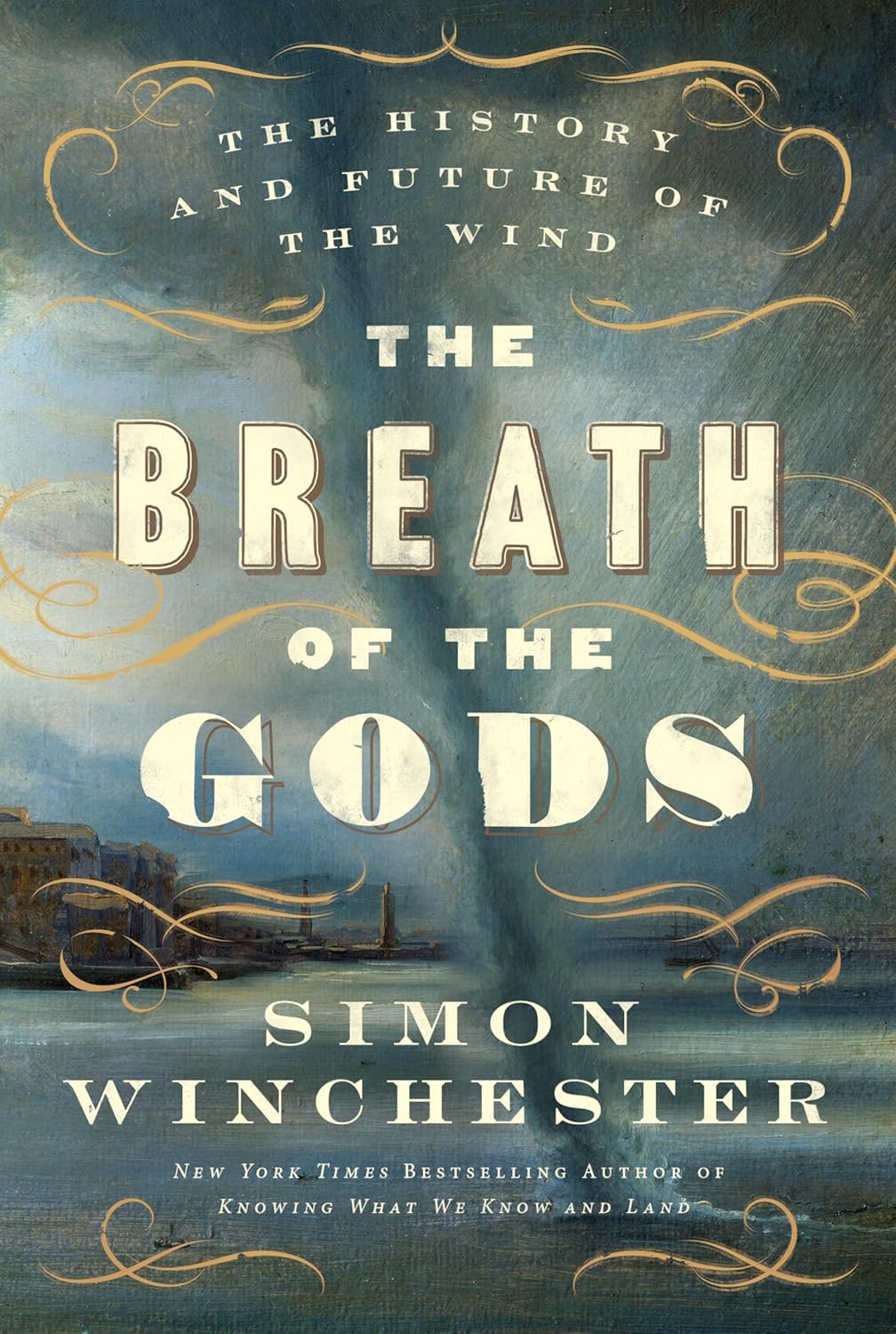
This is an unusual idea for a book. Winchester adds historical context to the science of wind.
Volcanic ash, nuclear fallout, dandelions, tumbleweeds, harmonic cave tones, sand dunes, kites, other planets (+Io +Titan +Triton), Coriolis, trade winds, jet streams, meteorology, exploration, the fate of battles, windmills, droughts, dust storms, crop failures, napalm, kamikazes, hurricanes, typhoons, cyclones, tornadoes, ...

Orcas are intelligent apex predators. The relationship between their species and ours is unusual. We can kill each other, but that rarely happens. Since the 1960s, some orcas have been held in captivity. Trainers and scientists have learned a lot about these magnificent animals. And because they are multimillion-dollar assets, they are typically treated well. Now, there are orcas born without ever knowing freedom. Perhaps humans can maintain a healthy relationship with killer whales, but each one belongs with their family in the open ocean.

Africa is vast. Many aspects of its developmental history are comparable to the rest of the world, but some things make it special and unique. An enormous desert, tropical forests, apex predators, disease-carrying mosquitoes, and disconnected waterways have hampered the continent's ability to achieve a high population density. Because of this, wars were not typically fought for land and empire. More likely, conflict arose for treasure, livestock, women, and slaves. The demand for slaves increased the number of warlords, authoritarian states, and militant raiders--taking the form of Saharan caravans, Swahili Coast slavers, the trans-Atlantic slave trade, and ultimately colonization. The dark side of colonization ranged from King Leopold's horrors enacted in the Congo to settlers staking claim to the most fertile soil. Post-colonial woes persisted. Unstable leadership and an over-focus on resource extraction have been problematic. However, Africa has a growing population of healthier, more educated, optimistic people. Plenty of good things in the future.

Delve into the histories of
★Rome ★Athens ★Istanbul ★Jerusalem ★Persepolis ★Delhi ★Hampi ★Xi'an ★Mexico City ★Tikal ★Cusco ★Ephesus ★Luxor ★Petra ★Damascus ★Babylon ★Leptis Magna ★Timbuktu ★Lalibela ★Great Zimbabwe ★Bagan ★Angkor ★London ★Paris ★Florence ★Prague ★Vienna ★Berlin ★Moscow ★Cairo ★Vcaranasi ★Bangkok ★Quebec City ★New Orleans ★Bordeaux ★Munich ★Bratislava ★Krakow ★Hanoi ★Melbourne ★Reno ★Minneapolis ★Detroit ★Montreal ★Dublin ★Amsterdam ★Stockholm ★Lisbon ★Barcelona ★Venice ★Cape Town ★Shanghai ★Sydney ★San Francisco ★New York City ★Havana ★Buenos Aires ★Belfast ★Copenhagen ★Marseilles ★Naples ★Lagos ★Osaka ★Vancouver ★Boston ★Maimi ★Cartagena ★Rio de Janeiro ★St. Petersburg ★Isfahan ★Singapore ★Kyoto ★Washington DC ★Brasilia ★Edinburgh ★Palmanova ★Valletta ★Baghdad ★Alexandria ★Chandigarh ★Jaipur ★Canberra ★Philadelphia ★La Plata ★Dubai ★Beijing ★Hong Kong ★Seoul ★Tokyo ★Los Angeles ★Rotterdam ★Baku ★Doha ★Abu Dhabi ★Astana ★Kuala Lumpur ★Seattle ★Chicago ★Toronto ★São Paulo

To commemorate the 99th anniversary of the NHL's founding, Gretzky wrote this book in 2016. The Great One writes about his experiences, but it is very different from most athlete bios. Much of the book is about the whole of hockey with all its legends and lore.

The archaeological record can help us speculate about:
Who Invented Inventions? | Who Discovered Fire? | Who Ate the First Oyster? | Who Invented Clothing? | Who Shot the First Arrow? | Who Painted the World’s First Masterpiece? | Who First Discovered the Americas? | Who Drank the First Beer? | Who Performed the First Surgery? | Who First Rode the Horse? | Who Invented the Wheel? | Who Was the Murderer in the First Murder Mystery? | Who Was the First Person Whose Name We Know? | Who Discovered Soap? | Who Caught the First Case of Smallpox?

Augustine of Hippo (354-430) grew up in Roman North Africa. He studied in Carthage, then spent time in Italy teaching philosophy and rhetoric. Ultimately, he moved back to Africa to found a monastery and spent the rest of his life traveling the Punic-speaking countryside, preaching and planting churches.
Saint Augustine has an incredible legacy of laying Christian theological and Western philosophical foundations. The Roman Empire was going through several changes during and around his life. Though many religions were still popular, Christianity grew, was legalized, and became official. The center of power shifted to Constantinople. Rome was sacked. Augustine personally experimented with many sins. Fittingly, his doctrine focused on topics that included unity, righteousness, and human limitation.

Close to being a great book.
It is a friendly, soft-hearted appeal to non-math types. Yet the author has a bravely defiant curiosity to explore the intangible mathematical world. Oddly, the writing is sprinkled with throwaway, biased (sometimes falsifiable), demagogic social commentary. Perhaps something was lost in translation between the American version I read and the original British version.

This book starts with unique Neolithic villages and settlements. It ends with the Bronze Age civilizational collapse. Climate change and mass violence are the prime culprits.
It is important to remember that there have been a wide range of cultures. All of them are making things up as they go along. Human history is far from linear. It is a tree with gnarly branches. It is not obvious what practices will succeed. And there are tons of people, languages, behaviors, and beliefs that we will never know about.

Railroads are seen as a natural emergence that coincided with the Industrial Revolution. Caught between a canal boom and the rise of automobiles, rails initially aided horse-drawn carts in and around British coal mines.
The simultaneous construction of the Charleston & Hamburg and the Baltimore & Ohio set in motion a race to transform America. In the 1860s, rails played an important role in the Civil War. And by the end of the decade, the networks stretched coast to coast. Enter the Gilded Age.
Bridges and tunnels. Cargo and business travel. Tourism and social prestige. Heists and fatal accidents. Scams and cruelty. Tycoons and politicians.
Competition from cars, trucks, and airplanes. A harsh decline. Government subsidies and bailouts.
Some operations are still maintained: primarily freight trains.

A sample of people who have done mind-altering drugs:
a Greek oracle, an Egyptian pharaoh, a Macedonian king, a Chinese emperor, a Christian saint, a Roman emperor, an Elite Islamic assassin group, an English playwright, an American founder, an American general, an American president, an English poet, a British queen, an Italian Pope, a German philosopher, a Dutch artist, an Austrian psychologist, a German fuhrer, an American philanthropist, a French philosopher, an American president, an American president, an American actor, an American tycoon, an American actress, an American artist, an American writer, an American musician, an American musician, an American chemist, a British author, an American academic, an American essayist, an American psychologist, an American biochemist, a British band, an American astrophysicist, an American baseball player, an American cybersecurity entrepreneur, an American tech magnate.

I love the motivation for this book. And it delivers.
Some people have an inventor's mindset. Laws that stifle that are toxic.
Durable flashlights! Air conditioning! Steel cable suspension bridges! Toilet paper! Bottle caps! Safety razors! Root beer! Automated glass factories! Electric power plants! Artificial limbs!
Long live freedom.

We get it. Legitimate governments have (some) legitimate expenses. But taxes impact behavior and primarily reduce economic activity. New taxes almost always produce less revenue than forecasted.
Amongst other things, there are taxes on income, excise, sin, windows, washing machines, automobiles, luxury, imports, art, property, estates, chicken, windfall profits, capital gains, transactions, buybacks, and wealth. Taxes typically come with loopholes, smuggling, negative externalities, unintended consequences, job losses, strange employment contracts, fewer growth opportunities, less economic mobility, lower charitable giving, the selling of assets to pay tax debts, international trade barriers, the micromanaging of Rube Goldberg-esque legal compliance, and an excessive amount of time filling out forms.
Some countries have relatively effective tax codes that work in real time and allow entrepreneurship to prosper. Estonia, for example. If taxes are not neutral, simple, transparent, and stable, the costs outweigh the benefits.


