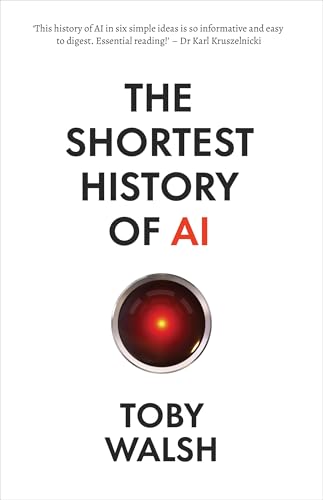
Before 1956, the idea of artificial intelligence existed in philosophy and fiction. In that year, at Dartmouth College, engineers began the first steps toward implementing AI algorithms. The 20th century saw exponential growth in hardware computational power and advances in robotics that laid a foundation for 21st century deep learning, reinforcement learning, backpropagation, neural networks, and transformers. Models have been trained on trillions of data points. Trillions of dollars have been poured into businesses dedicated to building AI products and infrastructure. So far, machines have gotten good at playing board games, chatting, and making automobiles more autonomous. It seems appropriate to assume that the revolution will impact every industry and everyone's life, analogous to the steam engine and electricity. AI doesn't "know" things; it is simply a probabilistic model predicting what is likely to be an optimized solution to a directive. Some outputs, however, are indistinguishable from magic. More to come.